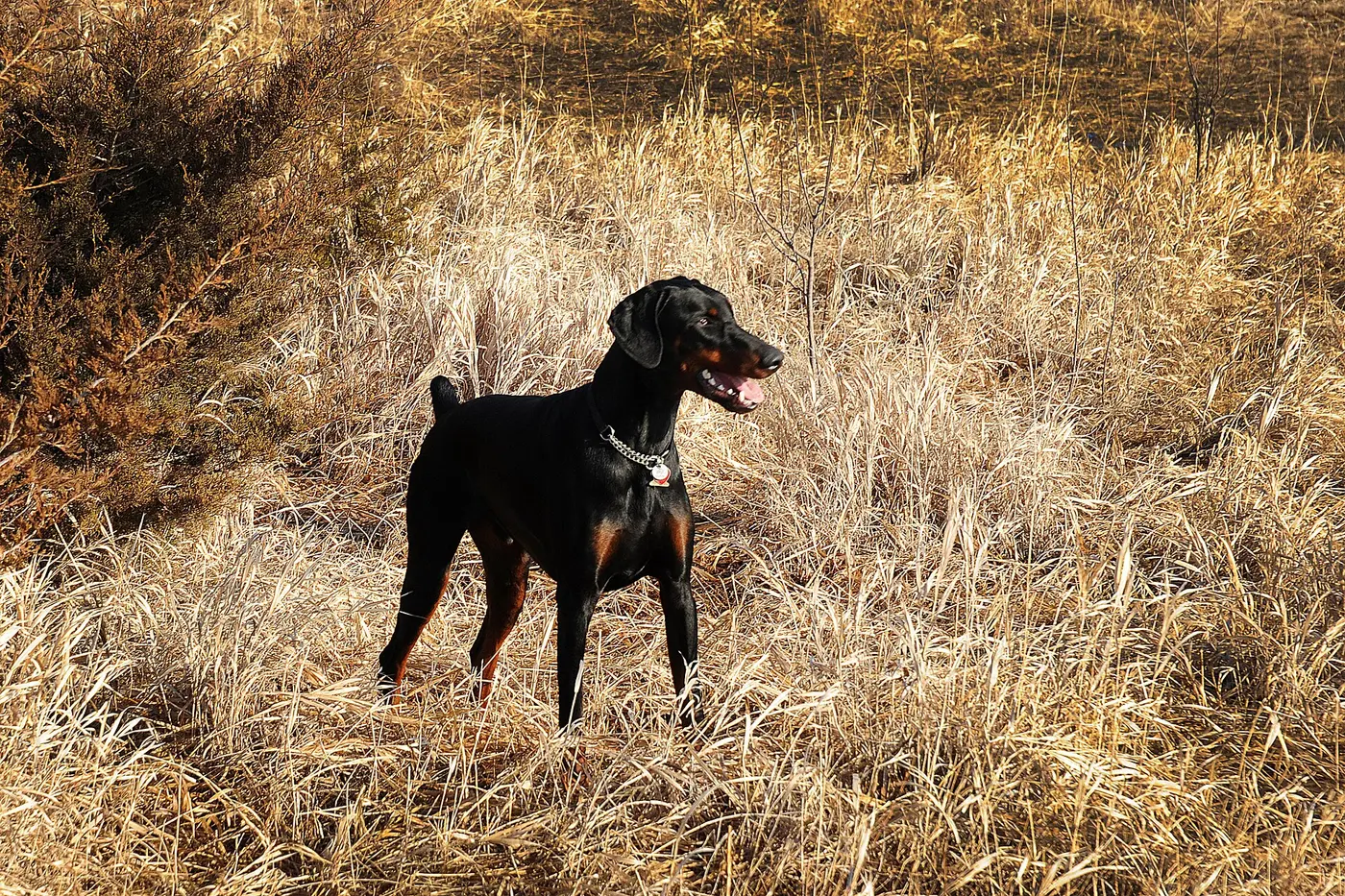
Tall grass and brush can put a dog in contact with questing ticks. Photo: Cleck, public domain, via Wikimedia Commons.

The walk is over, your dog is tired, and the sofa is calling. Before you settle in, spend a few minutes checking for unwanted passengers. Ticks can crawl through fur before choosing a place to attach, which means the easiest tick to deal with may be the one you find early.
The short answer: Check your dog as soon as you leave the park or arrive home. Do a slower, hands-on check later the same day, then continue with a daily check if your dog regularly spends time outdoors. Remove every attached tick as soon as you find it.
There is no universal two-hour safety window for dogs. The time needed to transmit infection varies by tick species, pathogen, and host. Lyme disease transmission usually requires longer attachment, but other tick-borne infections follow different timelines. Prompt removal is the safest rule.
💡 Key Takeaways
- Do a quick surface check before your dog gets into the car or enters the house.
- Repeat with a slow fingertip check later the same day, especially after time in grass or brush.
- Inspect the ears, eyelids, collar area, armpits, groin, toes, and tail.
- Use fine-tipped tweezers and steady pressure to remove an attached tick. Do not burn, twist, or smother it.
- Contact a vet if your dog seems unwell, has many ticks, or you cannot remove a tick safely.
When should you check your dog for ticks?
A useful routine has three layers. Each one catches something the others may miss.
Before you leave the park
Start with a quick brush-off beside the car or at the park gate. Run your hands over your dog’s back, sides, chest, legs, and tail. Look across the coat for anything moving.
An unattached tick may still be travelling across the fur. Finding it outside keeps it away from your car, furniture, other pets, and family members.
When you get home
Once you have good light and your dog is calm, carry out a slower fingertip check. Part long or dark fur down to the skin. This is a convenient time to inspect under the collar or harness and between every toe.
Aim to do this on the same day as the walk. A check within two hours is a practical habit because it is easy to remember, but it is not a guarantee against infection. The CDC advises checking outdoor pets every day and removing ticks right away.
Every day during tick exposure
Check daily if your dog uses grassy parks, trails, farms, scrubland, or wooded areas. Keep the routine during warm, humid, and rainy periods in your region, and follow your veterinarian’s advice about year-round prevention.
Do not skip the check because your dog takes a preventive tablet or wears a tick collar. Preventive products lower risk, but no product makes a dog impossible to bite. Your vet can help choose a product that fits your dog’s age, weight, health, and local tick species.
Where do ticks hide on dogs?
Ticks often settle where the skin is thin, warm, or protected from grooming. They can attach anywhere, so begin at the nose and work toward the tail in the same order each time.
- in and behind the ears
- around the eyelids and under the chin
- beneath the collar, harness, or clothing
- under the front legs and in the armpits
- between the back legs and around the groin
- between the toes, beside the pads, and around the nails
- around the tail and anus
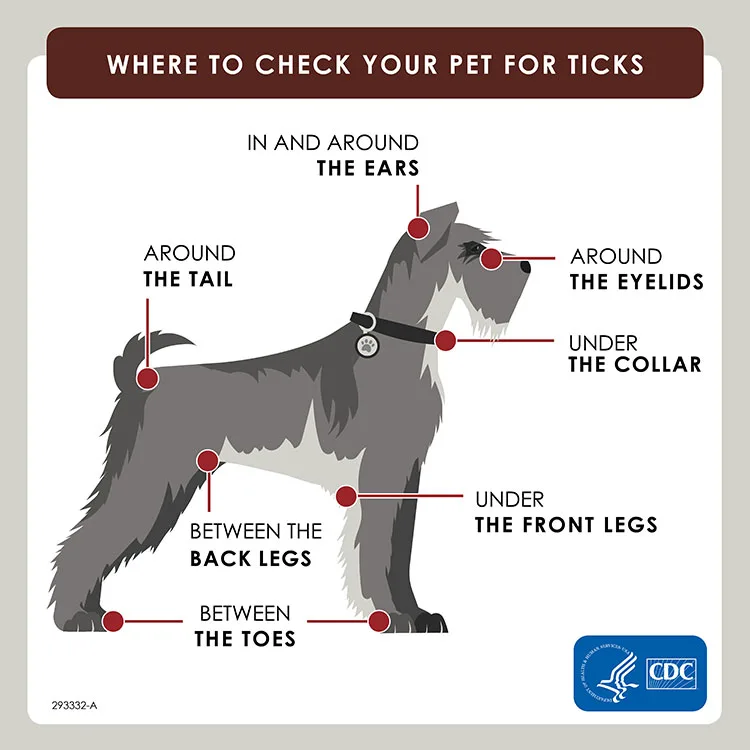
Common tick-check locations on a dog. Image: U.S. Centers for Disease Control and Prevention, public domain. See the CDC tick-check guide.
Pay extra attention to folds, feathered fur, and areas your dog cannot easily scratch. On long-coated dogs, a tick may feel like a small seed before you can see it.
How do you perform a thorough tick check?
Choose a bright room and keep a fine-toothed comb, flashlight, and fine-tipped tweezers nearby. A lick mat or a few treats can help a restless dog stay still.
Remove walking gear
Take off the collar, harness, bandana, raincoat, and boots. Check the seams and fasteners before putting them away.
Scan the coat
Look for a crawling tick or a small dark shape attached to the skin. On light coats, inspect visually first. On dark coats, rely more on touch and a flashlight.
Feel against the direction of the fur
Use gentle pressure and move your fingertips against the lay of the coat. Investigate every bump instead of trying to scrape it away. Nipples, skin tags, and scabs can resemble ticks.
Inspect each hotspot
Check both sides of each ear, around the eyelids, below the collar, under every leg, through the groin, between every toe, and beneath the tail. Use a comb to divide a thick double coat into small sections.
Check yourself and your belongings
Ticks can ride indoors on leads, clothing, and backpacks. Inspect the people and gear that went to the park too.
What should you do if you find a tick?
Remove an attached tick promptly. If the shape is difficult to identify, use your phone camera or a magnifying glass. An attached tick usually has legs visible close to the skin. Do not pull at a lump if you are unsure whether it is a tick.
How to remove a tick safely
Put on disposable gloves if available. The Companion Animal Parasite Council recommends fine forceps, gloved hands, and slow, steady pressure.
Grasp close to the skin
Use clean, fine-tipped tweezers. Part the fur and grip the tick where its mouthparts enter the skin, without squeezing its swollen body.
Pull with steady pressure
Pull upward slowly and evenly. Do not jerk or twist. A sudden movement can break the mouthparts and leave them in the skin.
Clean the area
Wash the bite site and your hands with soap and water. Clean the tweezers with rubbing alcohol.
Contain the tick
Place it in a sealed container or wrap it firmly in tape. Do not crush it with bare fingers. Your vet may want a clear photo or the contained tick if your dog later becomes ill.
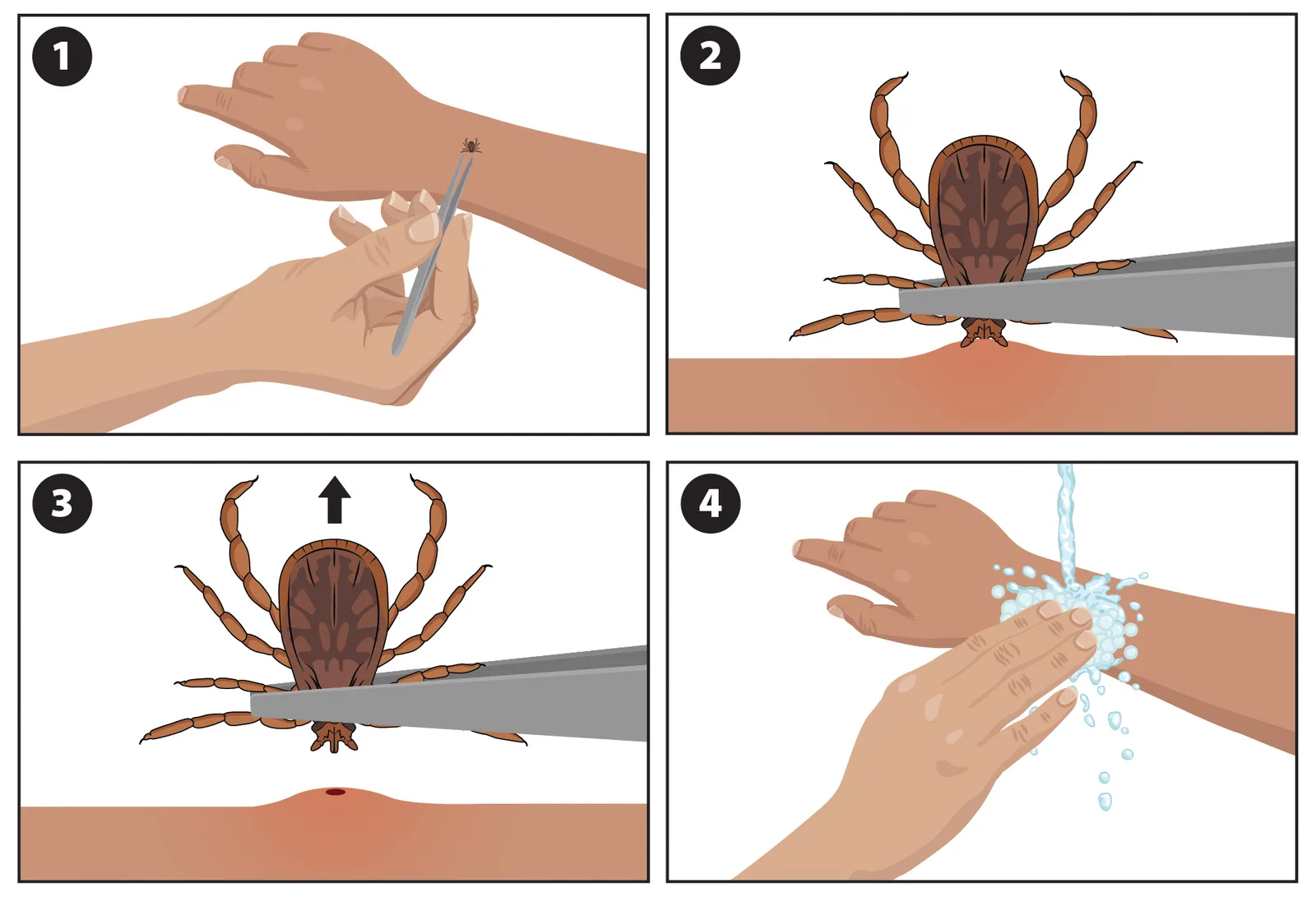
Grasp close to the skin, pull upward with steady pressure, then clean the area. Image: U.S. Centers for Disease Control and Prevention, public domain, via Wikimedia Commons.

Tick-removal methods to avoid
Do not cover the tick with petroleum jelly, nail polish, alcohol, essential oil, or another chemical while it remains attached. Do not hold a hot match near your dog. These methods delay removal, can injure the skin, and may cause the tick to release more fluid into the bite.
The American Veterinary Medical Association’s external-parasite guidance recommends tweezers and warns against alcohol, petroleum jelly, and hot matches as detachment methods.
Get help with difficult removals
Contact a vet if the tick is beside the eye or inside the ear canal, your dog will not stay still, part of the tick remains and is not easy to lift out, or the skin becomes red, painful, swollen, or produces discharge. A heavy infestation also needs prompt veterinary care.
What symptoms should you watch for after a tick bite?
Mark the date of the bite and watch your dog over the following weeks. The CDC notes that signs of tick-borne disease may take 7 to 21 days or longer to appear.
Contact a vet if you notice:
- fever, weakness, or unusual tiredness
- reduced appetite
- pale or yellow gums
- dark or reddish urine
- unexplained bruising or bleeding
- swollen lymph nodes
- limping, stiff movement, or painful joints
- vomiting, diarrhoea, coughing, or breathing difficulty
- poor balance, weakness in the legs, or collapse
These signs have many possible causes. Tell the vet about the tick exposure even if the bite happened weeks earlier. Babesiosis, sometimes called tick fever, can damage red blood cells and range from mild illness to rapidly severe disease. The Merck Veterinary Manual overview of babesiosis describes fever, weakness, anaemia, jaundice, and dark urine among its possible effects.
How can you reduce ticks after future walks?
A tick check works best alongside a vet-approved preventive plan.
- Ask your vet which oral treatment, spot-on product, spray, or collar suits your dog and location.
- Follow the weight range, dose, and timing on the label.
- Never use a dog tick product on a cat unless a veterinarian confirms it is safe.
- Keep grass short and clear leaf litter or dense brush from areas where your dog spends time.
- Wash bedding and inspect cracks if you repeatedly find brown dog ticks indoors.
- Recheck after grooming or bathing because wet, parted fur may reveal a bump you missed.
Frequently asked questions
Should I check my dog after every walk?
Check after walks through grass, brush, leaf litter, or wooded ground. A brief scan after ordinary neighbourhood walks is also sensible in areas where ticks are common. Outdoor dogs should receive a full check every day.
Is a tick check within two hours enough?
It is a good first deadline, not a guarantee. Check as soon as you can, repeat the search later that day, and maintain a daily routine. Different tick-borne pathogens can transmit on different schedules.
Will a bath remove ticks?
A bath may wash away some unattached ticks, but it cannot replace a fingertip check. Attached ticks can stay fixed to the skin through bathing.
What if the tick’s mouthparts stay in the skin?
Do not dig deeply into your dog’s skin. If the fragment does not lift out easily with clean tweezers, ask your vet what to do. Monitor the site for redness, swelling, pain, or discharge.
Can I prevent every tick bite?
No method is perfect. Vet-approved prevention, prompt checks, short grass, and quick removal work together to lower the risk.
Make the check part of coming home
Keep the routine simple. Lead off, gear checked, hands over the coat, toes inspected. The first pass takes a few minutes, and the slower check later that day covers the spots you could not see at the park.
Found a tick and cannot remove it safely, or is your dog acting unwell after a bite? A vet can guide removal, assess the bite site, and decide whether symptoms need testing or treatment.
🐾 Find your pet's perfect match on Pawgloo
Join the community of thousands of pet parents in India. Play dates, tele-vet access, and verified dog walkers-all in one app.
Use Pawgloo™ to speak with a tele-vet about tick removal and symptom monitoring. Seek an in-person or emergency vet immediately if your dog is weak, pale, struggling to breathe, bleeding unexpectedly, or collapsing.