You turn into your lane and see a familiar face at the window. Ears up. Tail moving. By the time your key reaches the lock, your dog is waiting behind the door.
Were they sitting there for eight hours? Did they somehow feel your car getting closer?
Probably not. Dogs do not need a sixth sense to make an impressive prediction. They have a remarkable nose, a wider hearing range than ours and an excellent memory for patterns. Your arrival also produces more clues than you may notice.
The short answer: Dogs cannot read the clock or know your travel plans. Many dogs can learn when you usually return and detect the sounds, smells and household changes that happen shortly before you arrive.
💡 Key Takeaways
- Dogs can distinguish their owner’s smell and voice from those of unfamiliar people.
- Dogs hear higher frequencies than humans, but there is no fixed distance from which every dog can hear a car.
- Daily routines and environmental changes can help a dog predict when familiar events will happen.
- The idea that dogs measure time through the fading strength of an owner’s scent is plausible, but not proven.
- A dog who suddenly stops responding to familiar sounds may need a veterinary hearing check.
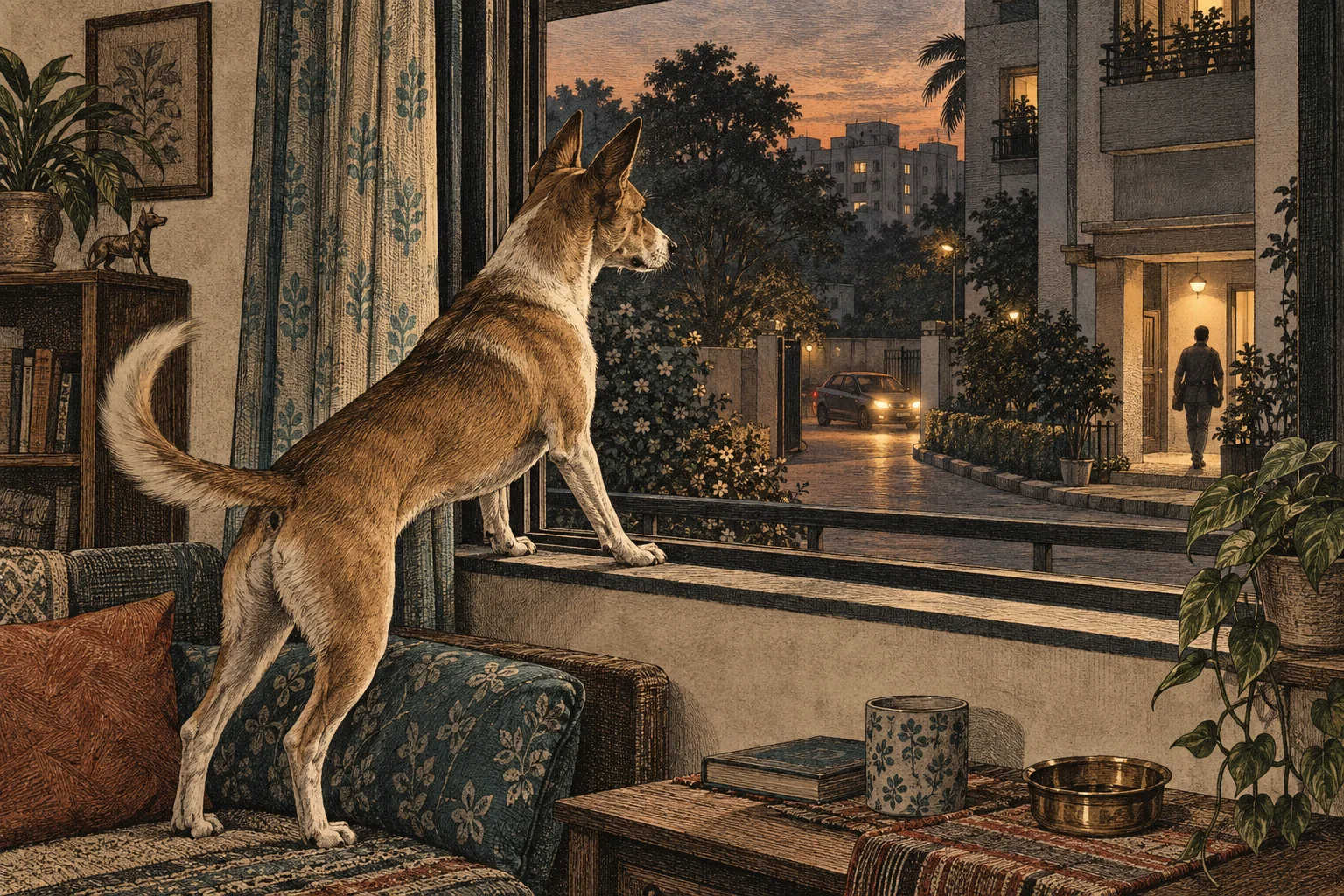
Your dog is making a prediction, not reading your mind
Think about everything that happens before you enter the house. Your car turns into the lane. A lift stops on your floor. The security gate opens. Your footsteps reach the corridor. Someone at home starts setting the table. Evening traffic changes outside.
Any one of those events may be ordinary. Repeated in the same order, they become a reliable sequence.
Dogs are skilled at learning associations. If the lift bell is regularly followed by your footsteps and then your arrival, the bell can trigger attention before you appear. The dog does not need to understand where you have been. They only need to learn what tends to happen next.
That also explains why the prediction sometimes fails. A similar car passes. A neighbour walks down the corridor. You work late. Your dog may check the door and then return to the sofa.
Can dogs smell time?
Dogs experience a detailed world of scent that humans can barely sample. A veterinary review reports more than 220 million olfactory receptors in the canine nasal cavity and notes that estimates of canine sensitivity vary with the odour being tested. The often repeated claim that a dog’s nose is 10,000 to 100,000 times as sensitive as ours is a reported range, not one universal measurement for every smell or every dog. Read the canine olfaction review.
Your smell also matters to your dog. In Alexandra Horowitz’s owner-odour research, pet dogs distinguished their owner’s odour from a stranger’s odour without being trained to do so. Read the study on person-odour discrimination.
Those findings show that dogs can recognise a person by smell. They do not show that a dog can calculate your arrival time from odour alone.
The fading-scent idea
The popular explanation goes like this. Your scent is strongest when you leave and gradually becomes weaker. If you return at roughly the same time each day, your dog may learn that a particular scent concentration predicts your return.
It is a clever hypothesis, often associated with Horowitz’s writing about how dogs experience odour. A television demonstration has also explored it. Controlled research has not yet established that pet dogs use household scent decay as a clock for an owner’s return.
Treat the scent clock as a hypothesis
Dogs can recognise human odour, and odour concentration changes over time. The missing step is direct evidence that dogs routinely use that fading concentration to predict when one person will come home.
Smell may still provide a near-arrival clue. Air moving through a stairwell, an open window or a corridor could carry fresh odour when you are already close. That is different from smelling you across an entire city.
Your car and footsteps have a sound signature
Dogs can hear higher-pitched sounds than people. Louisiana State University’s comparative hearing data gives an approximate range of 67 to 45,000 hertz for dogs and 64 to 23,000 hertz for humans. The university also warns that hearing limits depend on testing methods and sound intensity, so the figures should not be treated as a contest between species. See LSU’s canine hearing range data.
That wider range does not mean a dog can hear your car from a fixed number of kilometres away. Distance depends on the sound’s volume and pitch, walls, traffic, weather, the dog’s ear shape and the dog’s hearing health.
What dogs can do is learn an acoustic pattern. Your vehicle has a combination of engine tone, braking noise, indicator clicks and tyre sounds. Your keys, gait and the way you open the gate add another sequence. After enough repetitions, one part of that sequence may be enough to send your dog to the door.
Research also shows how finely dogs process familiar human sound. In a controlled voice-choice test, dogs selected their owner’s voice more often than an unfamiliar person’s voice. They used acoustic details such as pitch and voice irregularity to make the distinction. Read the owner-voice recognition study.
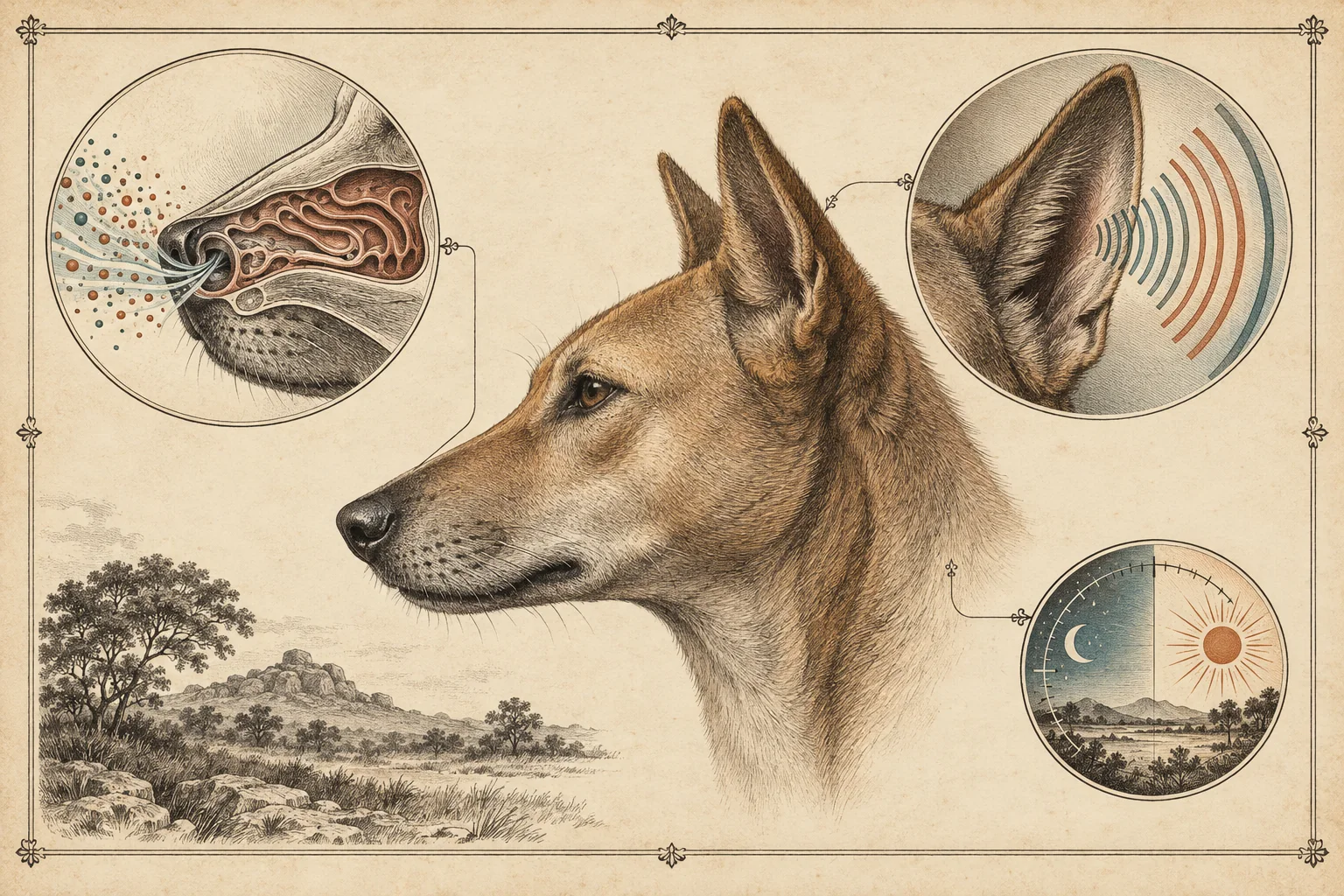
Smell, hearing and daily rhythms work together. This is an editorial illustration, not a diagnostic anatomy chart.
Routine gives dogs a rough timetable
Dogs have daily rest and activity rhythms. They do not need to know that it is 5:30 pm to notice that the house, their body and the neighbourhood have entered a familiar part of the day.
A study in the Journal of Veterinary Behavior found clear day and night activity patterns in adult dogs and examined how age and feeding frequency affected those rhythms. Other activity-monitor research shows that companion dogs share their environment and routine with humans, and that human activity influences when dogs rest and move. Read the canine sleep-wake study.
Useful time cues may include:
- the angle and brightness of daylight in a room
- a regular meal, walk or medication schedule
- school traffic, deliveries or neighbours returning home
- another family member changing rooms or starting dinner
- the usual length of the quiet period after you leave
Your dog is not tracking one perfect internal stopwatch. They are combining biological rhythm with events that repeat. The more regular your schedule, the easier it is to anticipate.
Which sense tells them first?
There is no single answer for every home.
An apartment dog may hear the lift and your footsteps. A dog in a detached house may notice a gate, vehicle or fresh scent near an open window. A dog living with several people may react to a family member’s behaviour before hearing you at all.
Age changes the balance. A dog with reduced hearing may rely more on vibration, vision and smell. A dog with nasal inflammation may miss scent information but still recognise the routine. Memory and attention also change across a dog’s life.
This is why “my dog always knows” is difficult to test from memory alone. We remember the dramatic correct predictions and often forget the five times the dog checked the window for a neighbour.
Try a gentle home observation
You can learn more about your dog’s cues without turning the day into a laboratory experiment.
Record the usual pattern
Use a pet camera for several normal arrivals. Note when your dog first lifts their head, approaches the window or waits at the door. Do not count ordinary movement as anticipation unless it consistently leads into your arrival routine.
Change one cue
On another day, return at a different time or use a different vehicle. Ask someone already at home to note the dog’s reaction. Change only one thing so the result is easier to interpret.
Compare several days
One correct prediction proves very little. Look for the same response across several ordinary days. You may find that the lift, gate or dinner routine predicts your arrival better than the clock.
Do not run surprise tests if your dog has separation anxiety. Watching for panic is not an enrichment activity. A dog who howls, drools, scratches exits or cannot settle while alone needs a welfare plan, not repeated experiments.
When a familiar welcome suddenly changes
A quieter greeting does not automatically mean your bond has weakened. Your dog may have been asleep, may not have heard you or may be in pain.
Book a veterinary check if your dog starts to:
- ignore familiar voices or sleep through loud household sounds
- startle when touched because they did not hear someone approach
- stop responding to sounds from one direction
- develop ear discharge, odour, redness, head shaking or persistent scratching
- seem confused about familiar routines, especially at night
- lose interest in food smells or struggle to find dropped treats
Ear disease, nasal problems, pain and age-related cognitive changes can affect how a dog responds to the world. A tele-vet can help you describe the change and choose the right next step. An ear examination or hearing test requires an in-person clinic.
Frequently asked questions
Can dogs sense when you are coming home?
Dogs can often anticipate a familiar arrival. The most likely explanation is a combination of routine, learned sounds, fresh scent and environmental changes. There is no good evidence that they use telepathy or a special sixth sense.
Can my dog hear my car before I arrive?
Possibly, once the car is close enough. Dogs can hear higher frequencies than humans and can learn recurring sound patterns. No scientific distance applies to every car, building or dog.
Can dogs smell their owners from far away?
Dogs can identify and track human odour under suitable conditions. Wind, airflow, humidity, terrain and competing smells affect how scent travels. A dog waiting inside is more likely to use fresh nearby scent alongside other cues than to smell an owner travelling across town.
Does my dog wait at the window all day?
Many dogs rest for large parts of the day and check the window when something catches their attention. A pet camera can show what your dog actually does. Persistent pacing, barking, destruction or escape attempts may point to separation distress.
The best explanation is also the sweetest
Your dog has spent months or years learning the small details that belong to you. The sound of your approach, the smell you carry and the shape of the household routine all mean the same thing: you are nearly home.
That welcome is not magic. It is memory, sensory skill and a relationship built through repetition.
If your dog no longer notices familiar sounds or smells, book a wellness conversation through Pawgloo™ Tele-vet. A veterinarian can help you decide whether the change needs an in-person ear, nose or neurological examination.